


How much longer will the space station fly?
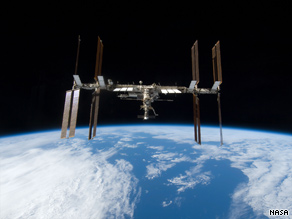
Flying 250 miles overhead, the international space station can be seen with the naked eye, orbiting the Earth every 90 minutes, usually carrying a crew of six. Now, before construction of the station is even complete, there is already talk of when the lights will be turned off.
NASA is waiting for the Obama administration to decide how much longer the station will fly and exactly which direction the U.S. space agency will take next -- a return to the moon, or maybe a trip to Mars?
The initial phase of the international space station was launched in 1998, although the station is still being expanded. The U.S. is one of 16 countries that help build and operate the station, whose laboratory runs a number of science experiments, including measuring the effects of space conditions, such as weightlessness, on humans.
The U.S. contribution to the space station so far: $44 billion. (NASA says it does not keep track of contributions from the other 15 partners.) NASA's funding of the space station is currently scheduled to end in 2016.
"The general idea that we would spend approximately 11 years building the space station, get it to its full operational capability, and then kind of abandon it a few years later ... doesn't make a lot of sense," said Robert Braun, a former NASA chief engineer. Braun currently is the director of Georgia Tech's Space Systems Design Laboratory.
0 comments:
Post a Comment